Wednesday, October 31, 2012

New Approaches to Photojournalism

Smartphones and Instagram

http://www.forbes.com/sites/jeffbercovici/2012/11/01/why-time-magazine-used-instagram-to-cover-hurricane-sandy/


Panorama shots:

An image from our former photojournalism grad student Jose Castillo,
who is currently designing iPad apps for American Express Publishing
in NY.  This view of the storm impact was shot from the roof of the
loft in Greenpoint Brooklyn. It was picked up by the NY Daily News blog and Huff Post.
http://i.imgur.com/FbYl5.jpg


"360 Panorama" app

http://occipital.com/360/app

http://static4.businessinsider.com/image/4fdba1e6eab8ea0368000006/360-panorama.jpg

http://burningbushhk.com/wp-content/uploads/2011/11/everest360panorama.jpg 

Be enthusiastic about photography!
 http://imgur.com/OQta8?tags

Multimedia Reporting on the New Building

J302F Video Project: What do you think about the new building?


BMC Video Project


by Alex Vickery, Cori Baker, Omar Longoria

Belo Center Project- Tiffany Hinman, Jasmin Carina, Minza Khan


Vivian, Larisa and Andy- Video Project


The quality's a bit grainy because it was uploaded as an mp4, but it should be fine.

Belo Center Project- Fata Haddox Garcia

Anna Fata
Victoria Garcia
Ryan Haddox


Belo story:


Here is our video!

Darren, Will, and Christy's Belo project

New Belo Center

Opinions about the Belo Center

Assignment 4: Video Shooting

Final Cut Project

http://www.youtube.com/watch?v=7tZ_7sT7J5Q&feature=youtu.be

Final Cut Project


Alexis & Celina

Our Project!

Belo Center Interviews

Assignment 4

Thursday, October 25, 2012

Tiffany Hinman and Jasmin Carina's project

After much, much technical difficulty, and two field trips to the tech services in the CMA, here's our project! Hurray!

Also, we're not a bunch of weirdos posting pictures of men in thongs. This was the Austin Thong Jog, and proceeds went to the homeless. It was in memory of Leslie Cochran!


Tiffany and Jasmin's project! Woooooo!

Wednesday, October 24, 2012

Victoria Garcia & Ryan Haddox's soundslides


https://webspace.utexas.edu/lg22535/untitled folder

Darren Mills and Will Korn's project

https://webspace.utexas.edu/whk264/project

Cori Baker & Alex Vickery Soundslides Project

15 Minutes of Fame

by Alex Vickery & Cori Baker

Garrett and Michael Slideshow

https://webspace.utexas.edu/gcc427/Project1/

Minza and Faria- Ross Bennett Audio Slideshow

Vivian and Anna soundslide project

file:///Users/vgo64/Documents/wine%20pics/wine/index.html

Britini Shaw and Stacie Richard Soundslides

https://webspace.utexas.edu/bs24739/shawrichard

Duncan Park

Hey guys! Here's Andrew Huygen and I's SoundSlides project:
https://webspace.utexas.edu/rl22654/duncan_park/

Casie Kruppa and Larissa Liska's Soundslide Project

Bridging the Gap Soundslide Project

News Video Example

'Walmart moms': The women who could decide which man wins

I thought this was a great example of a "good" news video. The video focuses on a relevant issue of today, which is a mother's view on the presidential candidates. The reporter decides to get two mothers with varied viewpoints, presenting their opinions through interviews at home, at work and while shopping at Wal-Mart. I thought it was a smart decision to only include the audio of those interviewed and not the interviewer as they are the focal point and through their answers we are able to realize what was being asked. Cinematography wise, the reporter chose a number of varied and unique shots while filming the mothers at work and while shopping, which added visual appeal to the story. Also, the decision to include superimposed facts over the video pertaining to the story was educational and relevant.

Tuesday, October 23, 2012

The Other Side

The project that Christy Reynolds and I did!

Which is here: 
https://webspace.utexas.edu/ojl76/publish_to_web/index.html

News Video Example

NEWS VIDEO EXAMPLE

Tallest Man Receives Size 24 Shoes 

I thought this was a great example of news video. The reporter from CNN.com begins with a short and direct introductory to the topic. Throughout the video, the narration is very "to the point", and the intonation of her voice keeps the viewer/listener interested. At first, I was a bit skeptical on the importance of the topic - aka: why should we care? Then the reporter answers that question by revealing the beneficial aspects of these shoes to the overall wellness of Igor's life. I also thought she did a nice job transitioning her interview clips with short narrations. In addition, the video clip was a perfect length. I didn't have any issues staying focused or getting bored with it. 

Soundslide Assignment


Here is our project! Hope all enjoy!

-Christy & Omar

:)

Sunday, October 21, 2012

News video example

http://www.cnn.com/video/?hpt=hp_c2#/video/us/2012/11/13/co-ufo-sightings-in-denver.kdvr


I thought overall this was a pretty good example of a news video, even though its a bit of strange topic and there were a few things I took issue with. At the beginning, the music they used in the background kind of gives the piece a bit of a satirical slant, like they aren't taking the story very seriously. I know UFO's are a goofy topic, but if you're going to run a story on one, at least make it appear serious. I liked the different use of the camera angles, for instance when they're filming the reporter through the lens of another camera. And I thought it was creative how they illustrated that they used their own cameras which still picked up the same sketchy video. I also liked the confirmation they got from the agencies about the story, adding a bit of validation to it.

Thursday, October 18, 2012

Interesting audio slideshow!

http://www.nytimes.com/interactive/2010/07/18/business/global/18shirt-audioss/index.html


I enjoyed this audio slideshow, minus some details. The beginning threw me off a little because of the Spanish audio clips.  I understood what they said but how are other non Spanish speakers going to know what they said? The music is very well matched with the content and pictures. The narrator's voice is good because it is calm but not monotone. It was a very clear and simple narration, easy to follow. There were definitely more pictures than there was audio but it worked. It wasn't overwhelming with the amount of information. It gives the listener time to look at the pictures and really focus on what is going on. I enjoyed the pictures that were outside of the factory because it shows the outcome/effect of the new factory. It is interesting to see the people working inside the factories as well. However, there could have been a transition intro to when the pictures change from the factory to the homes. It would have flowed a little better. Overall this slideshow was very enjoyable.


-HF

Wednesday, October 17, 2012

More Audio Slideshow Examples

Good Audio Slideshow Example

http://video.ft.com/v/1620120242001/Audio-slideshow-Where-China-bends-to-meet-the-world

This is a good audio slideshow because it has a good and clear storyline, showing how China bends to meet the world from the angle of one of the most modern cities in China, Shanghai. At first,the pictures in the slideshow have a theme set with the black and white content that depicts the old history of the city. Later,  it shows how Shanghai has developed throughout the years by combing its history in the past with the western culture in the present. I like the slideshow pretty much because it has interviews from lots of foreigners of different occupation,  telling their own experiences while working and living here in Shanghai, showing us that China has really taken progressive movement to meet the world.

Q&A

Audio formats: How does FLAC compare with MP3?
http://en.wikipedia.org/wiki/FLAC

Audio Slideshowwww -Omar J Longoria

http://www.nytimes.com/packages/html/nyregion/1-in-8-million/index.html#/michel_kramermetraux

This is a great audio slideshow which is just one of many in a great series on New Yorkers of all kinds and occupations, a way to take a look into the lives of 'average' people in what is generally viewed as a not-so-average town. This slideshow in particular might be a bit monotonous in the fact that it is mostly just the sound of the voice of the subject in question, Michel Kramer-Metraux, a wedding wardrober, speaking on his own history and on the methods and various seemingly random details of his life and occupation, it is interesting in that it follows the storyline of Michel himself, just sort of rambling on about who he is and what he does and whatever he personally feels is conducive to an understanding of the subject, himself, and his relation to it. The images themselves, while at time a bit staid, have a good variety, showing the subject at work, with other people he is involved with, and using different angles, lighting, mise-en-scene, and distance, with detail shots and such thrown in for variety and, well, more detail. Overall I think this is quite the cute little audio slideshow and a great series of audio slideshows, so the Grey Lady scores again.

-Omar J. Longoria

P.s. I don't feel like clicking on the link up there but if it doesn't go straight to it (Flash and all), just Google 'One in 8 Million' NY Times, and the one I used should be the very last one in the little, list thing, with the subject's name and occupation in the title and all.

Tuesday, October 16, 2012

Audio Slideshow behind the process

http://www.latimes.com/news/local/la-me-child-abuse_ss,0,3522985.htmlstory

This audio slideshow I think has a very good storyline and is clear throughout. The LA County Department of Children and Family Services is giving out second chances to troubled parents so they could keep kids from foster care. It is an experiment that they say is promising but also risky putting children back into homes. The pictures have a theme set with the black and white content that depicts a sad tone. I like how they interview different people through the social services and focus on one person , Darlene Compton, that is having her son taken away but are giving her a second chance. What they could have done better is getting more interviews and had more people talk. Or to even have a narrator or background noise. 

Audio Slideshow on Homelessness

http://www.guardian.co.uk/society/audioslideshow/2012/oct/10/homelessness-mario-story-audio-slideshow

For the most part, this extremely detailed audio slideshow is a good one. The photos are not only captivating but genuine, as the photojournalist describes that she documented his journey step by step. Every single event the journalist talks about is accompanied with a relevant photo (i.e. when she talks of him getting shot by air pellet gun, there are actual photos of the surgery!)

The progression of the story, from the moment she encounters him to the happy ending of him finally having a living space of his own and work, keeps you attentive as there are fallbacks along the way (moments when he has to return to sleep in the park, and the journalist is afraid he'll freeze to death as winter approaches).

My two criticisms for the video is the narrator's voice and the length. Considering she spent so much time with this man, you would assume she could sound a bit more emotional and engaged, but she persists in a monotone drone that makes you question how much she really cares.
The video is a bit lengthy, but this is understandable considering the elaborate topic. I think if the problem of the narrator's voice was fixed, the video wouldn't seem to drag out for so long.


Good example of an audio slideshow


http://www.bbc.co.uk/news/in-pictures-19060390

This audio slideshow is a little less than 4 minutes long.  It has a very emotional message for the viewer, which is why I selected it as an example.  While the narrator can be hard to understand at times, the slideshow provides high quality pictures that tell the story of an oppressed Somalian people in a secluded coastal town, in need of urgent medical care.  The pictures appeal to the viewers' emotions, and this is the greatest strength of the slideshow.

Monday, October 15, 2012

bad podcast

http://kids.learnoutloud.com/Kids-Free-Stuff/Literature/European-Classics/Childrens-Fun-Storytime-Podcast/23099

I picked this podcast because I figured that out of all the podcasts out there that are political, informative, sad, etc, they all have their tone. This is a website that have podcasts of childrens books. Like this one, Peter Rabbit, is a childrens book well known. However, when I was listening to the the podcast, I was very disappointed in the recording! Usually, people who read childrens books or narrate childrens books should take into account that CHILDREN would be the ones to listen to these podcasts and should be entertained. This podcast is narrated by a male who for all the voices, keeps the same tone! In the beginning it even seems forced like there is no enthusiasm like he does not want to do this or was forced to do it. He sounds so sarcastic. Another thing is that I feel like it drags and drags. Personally This story did not appeal to me because there was no "story" going on. Nothing in the podcast was entertaining. I honestly feel like If i showed this to a little kid, he/she will be bored out of their mind. Children have a big imagination, these books are supposed to be read with different voices, not like you are reading the constitution... BORING!

Good Podcast

http://app1.kuhf.org/articles/1344961767-Hundreds-Of-Undocumented-Houstonians-Prepare-To-Apply-For-Immigration-Program.html

The message  is concise, straight forward, and informative. It's a short poadcast posted on the KUHF site on Houstonians applying to a new immigration program giving, "qualifying undocumented immigrants work permits and temporary relief from deportation." Although she could have spoken up with a confident tone, I think she did well telling the story and quoting people. I personally have a short attention span so the fact she made it 2 minutes long was perfect. I also think background noise makes it a bit more interesting.

Podcast example

Kennedy missile crisis anniversary.

This is a little longer than 4 minutes, but you can get the gist of what is good and bad about this podcast prior to that. One of the most annoying things is the old recordings directly from the time of the crisis that you can't understand a word they are saying. I would just as well they kept these specific ones out and had the narrator just quote them. It is almost as annoying when she repeats word for word what the recorded clippings just said when they are actually clear and understandable. The narrator herself has an even pace and rarely stumbles. She does over enunciate at times, especially when saying words that start with a 'p'. The lady in charge of the memorial for the crisis uses the phrase uh or um several times and stumbles decently frequently. Overall I like the concept, and using the clippings from the time is interesting. I just wish they stuck to the ones that were clear.

Sunday, October 14, 2012

Good audio podcast ex.

Listen to the podcast here!


I selected this podcast from The Texas Tribune’s website, which originally aired on KUT News. The podcast, entitled “For Doctors in Politics, Medicine Often Trumps Party”, informs listeners about how doctors have always had a reputation for having scattered political views, some physicians considering themselves very liberal and others considering themselves rather conservative. For most physicians, though, their occupation trumps their political stance, meaning that being a democrat or republican will not compare to the experience they have had in the medical field and the opinions about health care they have formed because of this. According to the podcast, the number of doctors in politics is increasing.

The podcast includes sound bytes from some very important public figures, such as Congressman Ron Paul, Senator Bob Deuell and Congressman Michael Burgess. Because these are popular politicians, the podcast seems quite credible. The speaker also maintains a great balance of telling factual parts of the story while letting the sound bytes tell opinionated parts of the story. This balance of both the speaker and sources telling the story helps the podcast flow easily while maintaining the interest of the listener without becoming bored with too much information from either the speaker or the sources. The speaker’s voice sounds genuinely interested in the story he is telling, and uses phrases, such as “put him in hot water”, that make the listener feel like the speaker is talking directly to them on their level. The speaker also does his best to explain any issue that may be confusing to a listener that isn’t familiar with.

This is a very good informative and straight to the point audio podcast, but there are some things that could have been done to make it better. For example, the sound bytes all sound as if they are conducted via telephone, which make it a little less personal. It could have seemed a little bit more personal and convincing had the sound bytes been from an event at which the politician spoke at and thus gave these opinions. This would have also created more ambient noise from the audience, which the podcast lacked.

All in all, this is a good podcast that could have improved with some minor changes.

Friday, October 12, 2012

Good Audio Podcast Example

http://www.npr.org/blogs/thesalt/2012/10/12/162733830/the-secret-to-genius-it-might-be-more-chocolate

This podcast, from NPR's All Things Considered, highlights a study published in the New England Journal of Medicine that reports "a country's propensity for producing Nobel laureates might just be correlated to its national appetite" for chocolate. The study, described in the article as "tounge-in-cheek" displays the correlation between flavanols, which occur naturally in products like tea and chocolate, and the regression of cognitive aging as well as a correlation between chocolate consumption and Nobel winners. The podcast itself is a brief overview of the topic; the narrator speaks quickly but enunciates enough to be understood and does so with a humorous inflection. It is a good example of an audio podcast: clear and engaging as wes all brief and informative.

Political candidates in photos

Tuesday, October 9, 2012

Good Podcast Example


The podcast that I chose is from The New Yorker. It is a weekly podcast titled, “The Outloud Podcast.” This podcast in particular is about the rise of “K-POP” (Korean pop music) in America. It is a fifteen-minute podcast. It starts off with a few brief discussion about the top stories in The New Yorker then it moves on to the primary podcast topic, “K-POP.” I think that this is a wonderful example of an entertaining, fun and informative podcast. John Seabrook delves into the heart of K-POP in the podcast by discussing all aspects of the music and what makes it unique. When I listened I was constantly engaged while still gathering all the facts about the story. It was like I was hearing a story from a friend, not listening to an entertainment news story. Lots of sound effects, ambient noises and interviews are used to keep the listener captivated throughout the entire podcast. It is a perfect blend of them all. All of the above factors are reasons why I think this is a great podcast.

Sunday, October 7, 2012

Good Podcast Example

http://podcast.mktw.net/wsj/audio/20121006/pod-wsjtmit/pod-wsjtmit.mp3

I chose a podcast from The Wall Street Journal, which was published on October 6, 2012. This podcast discusses what's going on with the job markets, how to deal with airline delays, and what it takes to deal with the MLB postseason. I think this is a great podcast because they interview various credible sources, there are good transitions between stories, and the information they discuss seems to be unbiased and presented in an interesting way. The reporters used in this podcast speak clearly and have nice voices to listen to. I also felt the topics they chose are current and listeners can relate to the stories.

Friday, October 5, 2012

Faria's Photo project


This is a good photo because of the focus on the man in the front and the blurred but yet visible line of people in the back. The focus on the man hints at the difficulty of an individual in finding employement, but the blurred line behind not only gives depth to the frame but subtly shows how many people in our nation are in that situation. What prevents it from being a great photo I believe is the bad cropping, with an awkward white bar at the bottom. The lighting also isn't very good, and placing the caption on the right side is very distracting. Overall however, I believe it to be a good photo.-CNN

This is a bad photo. While the lighting is good, Obama's face being turned away and his daughter's being a downward frown tells us very little in way of what the photo means. The background of greenery is very typical and boring, as is having the subjects dead set in the center of the photo. It's a very plain, boring photo, with nothing to make it exceptional or even better than a very bare version.-The Onion

Photo Critque

I happen to find two different images involving the same story. One I didn't like and the other I did like.

I like this one a lot. It's with the story covering how the jobless rate has fallen to 7.8%- the lowest it's been. With their faces being shadowed it conveys that, yes jobs have increased, but it's not really any better. It gives off the feeling of a dark, depressing place with the rain falling in the back ground. Like even though it's raining outside and reviving the world, on the inside it's still a doomed world.

While this is a great photo as well and I like the fact it's focused on the background instead of the foreground. I'm not a fan of the photo itself. She kinda looks like she's thinking about something else entirely. I would have like to see it from a different angle. Perhaps more on the people arguing or the guy?

News photo critique

I decided to critique one photo I loved, and one that was so terrible I was just confused by its presence online. Enjoy!

From TIME Lightbox, by the photo editors of TIME magazine:


I loved this photo for many reasons. Technically speaking it's an excellent photo because of its use of layering and the rule of thirds. Additionally I was able to notice the concept of micro-composition, which Professor De Cesare explained to us, by looking at the man's eye through the trigger guard of his gun.
Beyond being a technically excellent photo, there is plenty of emotion present and really creates a reaction in the viewer. It conjures up a feeling of fear, which I think is hard to do in a photo; the fact that you see the eyes of the gang member and nothing else helps the viewer to connect with him without revealing his whole face. The story is about gang violence in Caracas, but the photo itself seems to tell a story.

From the Texas Tribune:


I was baffled by the awful-ness of this photo. The strange teal background is tacky and confusing- it seems like they were trying to fill up space on the page, but it just makes it an eyesore. It's a photo of the state's Medicaid chief Billy Millwee, but it's tiny so you can barely see him, and there is an obvious flash. You still have no idea that the story is about Medicaid just by glancing at the page.

Thursday, October 4, 2012

photo critique, otherwise known as "pretty pictures"


This photo caught my attention for many different reasons. First, the subject is clear. Depth of field allowed the photographer to highlight Ms. Pao while keeping the background of the picture out of focus yet dynamic, with vibrant, complementary colors. Second, which I just mentioned, is the complementary nature of the colors of the photo - they all complement each other and yet subtly allow Ms. Pao to become the focus of the picture. Third, is the natural lighting. There was not a flash used, which allows a natural, elegant, and flattering tone. Fourth, the photographer is obviously well-versed in the rule of thirds. Overall, the effect is very professional. [If you read the article, I think we can assume that was the purpose of the photographer given that Ms. Pao was fired.]


I found this photo in an article about the reaction to Wednesday night's debate. Most of all, I think I enjoy this photo because it is not the typical political candidate photo. It is not only coming from a different perspective, but like the first photo I chose, it is using depth of field to create a feeling. The subject is not the president, but instead the people in the crowd. It seems like the photographer is wondering what the voters think and highlighting their reaction. Once again, the photographer used natural lighting and lucked out with President Obama's black clothing, which provides a contrast to the crowd.


This photo was not from an article, which is why I have three pictures. But I found it so interesting that I felt it behooved me to share it. I found the photo on National Geographic's "Photo of the Day" from Sept. 20. It is titled "Winter, Pakistan." I like many things about this photo (some of which we heard about in class on Wednesday): the graphic element with an organic symmetry of the trees as well as reflection off the water, the mood of the photo communicated through the color and stillness of the photo as well as the quality of light, and the use of the rule of thirds, all of which add up to an incredible sense of place.

Photo Assignment

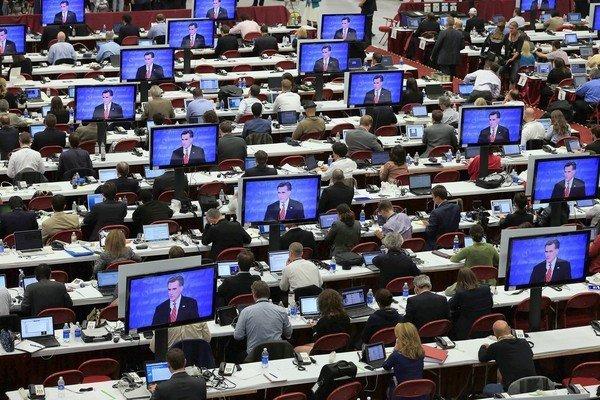
I decided to stay current and critique two photos of people watching the presidential debate.


This is a photo of reporters and fact-checkers watching the debate at the University of Denver. The corresponding article addresses how fact-checkers were among the toughest critics of the debate, as both candidates strayed from the truth.

The photo does a great job at showing the extent of coverage goes into such a large event. The repetition of Romney's face on numerous large television screens adds to this effect, since it seems like everyone is really "tuned-in". Also, the photographer took the photo from above, which I felt was to show how many people were working and reporting, not necessarily to make them seem small and unimportant.


This photo from the New York Times conveys a completely different atmosphere than the first photo. The photo places the viewer right in the scene, unlike the first photo, which took more of an observational approach. Composition-wise, the photographer utilized rule of thirds and great perspective with depth of field. Overall, this photo is much more laid back and approaches the debate watch with a casual vibe.

Photos

I picked one photo I liked, and one I didn't.


I found this photo from a story NPR featured about the defeat of President Mikheil Saakashvili in the Georgia parliamentary elections. I liked the picture because of the angle it portrayed the winner, Bidzina Ivanishvili. By shooting the picture at a lower angle, the photographer conveyed him as victorious and powerful as he looks upon his supporters. He is positioned in the left-middle region and is clearly the focus of the photo. However, there is still a story in the background and entices the viewer to "read" the story in the picture.


This photo came from a CNN story commenting on the lack of enthusiasm regarding the new Apple iPhone. The picture is supposed to depict a lone tent outside waiting for the new phone's release. However, when I first saw this picture I was confused what the focus actually was. The photographer could have chosen a more creative angle, but instead chose broad view that seems to focus on the shopping center itself more than the tent. The colors are also dull and could use some enhancing.  

Photos

I have two bad examples of news photos.
I got this photo from my hometown newpaper's website. The story is about Rice producers and a study saying rice crops have have included arsenic.  The photo is trying to show the rice truck being filled, but I think the point of it gets lost.  The first thing my eyes were drawn to was the back of the truck where the ladder is, not the rice.  The photo does not tell the story well, and in general I don't think it is a very interesting photo. The photographer maybe should of shot from a different angle or tried to get more focus on the rice and the worker beside it. This shot seems like a point and shoot shot that anyone could have gotten.

My second photo I got from the Victoria Advocate.
To be fair, I don't think the publication took this photo but I do think they could have found a better photo to publish or just left this one out all together.  This photo shows the subject of the story, but I just think its really boring. There is no depth of field, no emotion, and the backdrop looks like someone threw a sheet back there to take a photo. The article is about couples claiming this seat is unsafe and filing suit after their children were injured. There could have been opportunity to get an emotional picture with these people. Also the seat is sold at target, I honestly think a photo outside of a target would have been better than this one.

News Photos


The first photo I chose was from an article in The Daily Texan this week. 
What I liked about this photo was:
- Depth of field: The foreground was in focus which put the attention on the speaker, a former UT student who organized the protest.
- Emotion: It captured the emotion of the speaker as well as the emotions of those in the background


- Setting: The setting of the photo gives it context. The sign in the background show what is going on and the people watching from the apartments in the background show that residents in the area were curious about what was going on.
This photo I chose was from an article on the main home page of the Houston Chronicle about the FBI arresting the CEO of a hospital.

What I didn't like about this photo was:
- No depth or emotion: I didn't think the photo was really showing anything of significance in relation to the story. Even though it shows the hospital of the CEO that got arrested, the shot could have been much more interesting.
- Angle: The shot is straight on, there is nothing intriguing about this that makes me want to look at it or remember it afterwards.
- Expectation: I, or anyone for that matter, could have gone to the location taken this shot with a point and shoot camera. There was a slideshow of photos for the article, but if this was the main one chosen on the front page of the Houston Chronicle's website, it could be a lot better.


Wednesday, October 3, 2012

Photo Slideshow-NYTimes

http://www.nytimes.com/slideshow/2012/09/16/travel/16LATAM-28.html


I really enjoy the colors in photo 3. It's a great combination of the typical Mexican foods.
The clouds in the back of the cathedral contrast well with the dark copper of the building. Photo 8.
Photo 11 brings something different to the table. The fact that you can't distinguish the peoples faces is interesting and it makes you focus on the picture as a whole.
I like the angle and the subject of photo 14. It gives a sense of peace with the color of the water.
Photo 18 looks like a dream. The colors are breathtaking and the photo is taken far away from the ocean but close enough to get a sense of it in the picture.
I love pictures that capture the hustle and bustle of the town. It's important to have a picture of it because everyone and everything moves so fast. I think every town has something beautiful about it.
Picture 28 is of a family. A common family but you can see something in their eyes. You can see the struggle they've been through and you can see the hope that shines through them.

Britny's Still Photographs

I know that we were only required to find two photos that we liked or didn't like for specific reasons, but because I found one in a sports story and I wasn't sure if that counted, I went ahead and looked up three different examples.

First is this photo of Texas Rangers third baseman Michael Young from an article in the Dallas Morning News (source: Dallas Morning News). 

I liked this photo for several reasons. First, it clearly follows the rule of thirds. Second, I enjoy the technique the photographer used of keeping the background - the celebrating Oakland A's - blurred and focusing on Young and the restrained emotion on his face.

Next is this photo from a story about veteran overdoses done by the Statesman (source: Austin American Statesman). This photo is focusing on the memorial for Chance Cody Hausinger, and it also caught my eye for several reasons. The lighting is very nice, for one thing, and the angle is an interesting change from just shooting the wall from directly in front of it. By shooting from below, the photo is given more depth and also, in my opinion, a metaphor is created - that of the deceased's souls moving upward, "toward the heavens," and so on.


Finally, there is this photo of the weeping widow of Chad Mitchell, another veteran, from the same Statesman story (source: Austin American Statesman). I chose this photo for different reasons than the two previous. With the last two photos, I was looking for a combination of good techniques and interesting angles culminating in a pleasing photo. But with this photograph, though those things are present in part, the main impact comes from the overwhelming emotion of the woman. That alone makes this a good photo.